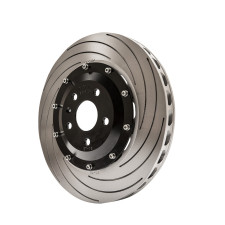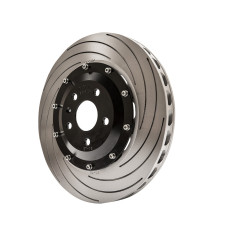
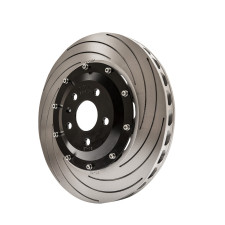
Bowl-type brake discs
Hollow-center brake discs are used to enhance or modify the braking systems of sports cars and race cars. Unlike a solid-disc brake disc, they combine a braking surface with a separate central hub, typically made of aluminum. This design optimizes the overall weight of the assembly and allows for various mounting solutions tailored to the thermal stresses of braking.
In rallying, on the track, or in hill climbs, repeated braking subjects the discs to high temperatures. Hub-mounted discs can withstand these stresses thanks to their design, while allowing, on certain models, the original calipers to be retained or only the worn braking surfaces to be replaced.
Design of Aluminum-Housing Brake Discs
A two-piece brake disc consists of a friction surface—typically made of cast iron—and a hub that provides its mounting to the wheel hub. Using an aluminum hub reduces the weight of this central component compared to an all-cast-iron design, depending on the sizes and materials used.
The friction surfaces can be smooth, grooved, or pierced, with ventilation systems and characteristics that vary by manufacturer. The choice of design depends in particular on operating temperatures, mechanical stresses, and the intended use.
Reduction of Unsprung Mass and Vehicle Handling
Reducing unsprung mass is one of the main benefits sought with aluminum-cased brake discs. This mass includes, in particular, some suspension components, the wheels, and the braking components.
By dropping the weight of some of these components, it is possible to ease the load on the suspension and improve its ability to follow road irregularities. A lighter assembly can also reduce rotational inertia, depending on its mass distribution.
The actual weight savings, however, depend on the disc’s sizes and design. A bowl-mounted disc is not necessarily lighter than all one-piece or carbon-ceramic discs.
Thermal Management and Fixed, Semi-Floating, or Floating Rotors
During heavy braking, the braking surface heats up and grows. The connection between the braking surface and the hub affects how these stresses are transmitted to the assembly.
Fixed discs mounted on a hub have a rigid connection between the two components. Semi-floating and floating mountings, depending on their design, allow for certain controlled movements to better accommodate the thermal expansion of the friction surface.
These solutions can help limit certain mechanical stresses during significant temperature fluctuations. However, they do not guarantee the absence of deformation or vibrations, which also depend on the mounting and operating conditions.
Compatibility with Original Equipment Brake Calipers
Some bowl-style brake discs are designed to directly replace the original discs while retaining the original brake calipers. This allows you to modify the disc design without necessarily installing a complete big brake kit.
Other models are designed for specific braking systems, particularly those with racing calipers. Compatibility must be verified based on the rotor diameter, thickness, offset, center distance, and geometry, as well as the caliper and the available space within the rim.
Brake pads must also be suitable for track use and the expected operating temperatures.
Converting Carbon-Ceramic Brakes to Cast-Iron Brake Discs
Some sports cars come equipped with carbon-ceramic brake discs as standard. For intensive use, particularly on the track, solutions are available to replace these discs with cast-iron-core assemblies.
This conversion from carbon-ceramic to cast iron can be cost-effective when replacements are needed due to wear. On some removable kits, only the metal track can then be replaced, while retaining the hub if its condition allows.
Depending on the application, the conversion can be performed while retaining the original calipers. However, it requires discs of the appropriate sizes and brake pads compatible with the metal tracks.
This conversion does not guarantee a weight reduction: the original carbon-ceramic rotors may be lighter than cast iron assemblies. Technical compatibility and compliance with the intended use must be verified for each kit.
Replacing the Brake Lining and Maintaining Discs with a Removable Disc Bell
On removable hub-mounted rotors, the braking surface can be replaced independently of the central hub. This design allows part of the assembly to be retained when the braking surface reaches its wear limit, provided the manufacturer authorizes this procedure.
Replacement requires inspecting the condition of the hub, mounting fasteners, and mating surfaces. Tightening torques, any fasteners used only once, and mounting procedures must comply with the manufacturer’s instructions.
After installing new discs, it is essential to perform a break-in procedure appropriate for the discs and pads. For sports or competition use, the selection of high-temperature brake fluid and the good condition of the entire hydraulic unit also contribute to consistent braking performance.
Check your car's compatibility
You do not have any car selected. Identify it to ensure product compatibility.
Can't find the part you're looking for? Contact our team or call us on +41 (0)21 946 22 32, we'll help you find it.